
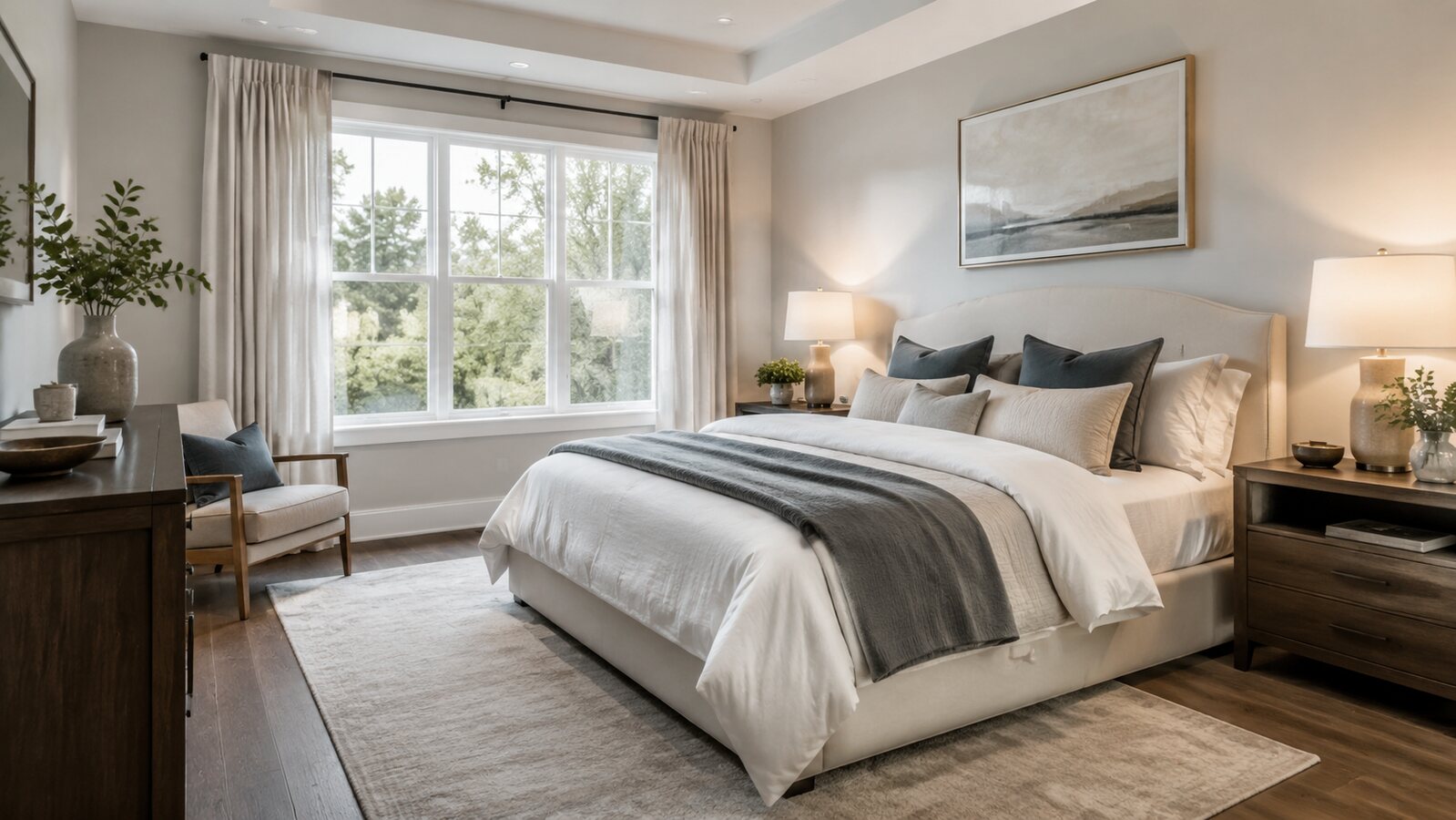
Bedroom lighting must support dressing, reading, cleaning, and safe nighttime movement without making the room feel like an office. Separating these needs into layers gives better control than relying on one bright ceiling light.
Plan controls from the bed and doorway
The most useful lighting plan can be operated where routines happen. A switch at the entrance handles general light, while reachable bedside controls prevent walking across a dark room. Renters can achieve much of this with plug-in lamps and smart controls, provided cords remain safe.
A practical step-by-step plan
- Use a soft general light for orientation and routine tasks.
- Place focused reading lights so the page is illuminated without shining into the other side of the bed.
- Add wardrobe or mirror lighting where color accuracy and visibility matter.
- Provide a low-level path light for nighttime movement.
- Use blackout curtains for darkness rather than expecting dim bulbs to solve exterior light.
Select fixtures that fit the bedside arrangement
Wall-mounted lights free nightstand space, but installation and adjustable reach require planning. Table lamps should leave room for essentials and have stable bases. Pendants can work in a coordinated design but must be positioned so nobody strikes them when getting into bed.
Common mistakes to avoid
Tiny lamps with opaque shades may be decorative but ineffective for reading. Exposed bright bulbs create glare at reclining eye level. Avoid cords stretched behind pillows, overloaded adapters, and switches that require reaching past hot bulbs or unstable objects.
Before you buy or begin
- Measure lamp height relative to the mattress and seated reading position.
- Check bulb brightness, color temperature, and fixture rating.
- Give each sleeper independent control when possible.
- Secure cords and keep charging devices ventilated.
- Test the darkest walking route from bed to door.
Final perspective
Comfort comes from control: a gentle ambient layer, a precise task layer, and safe low light when needed. Position lights from the user’s point of view, not only for symmetry.